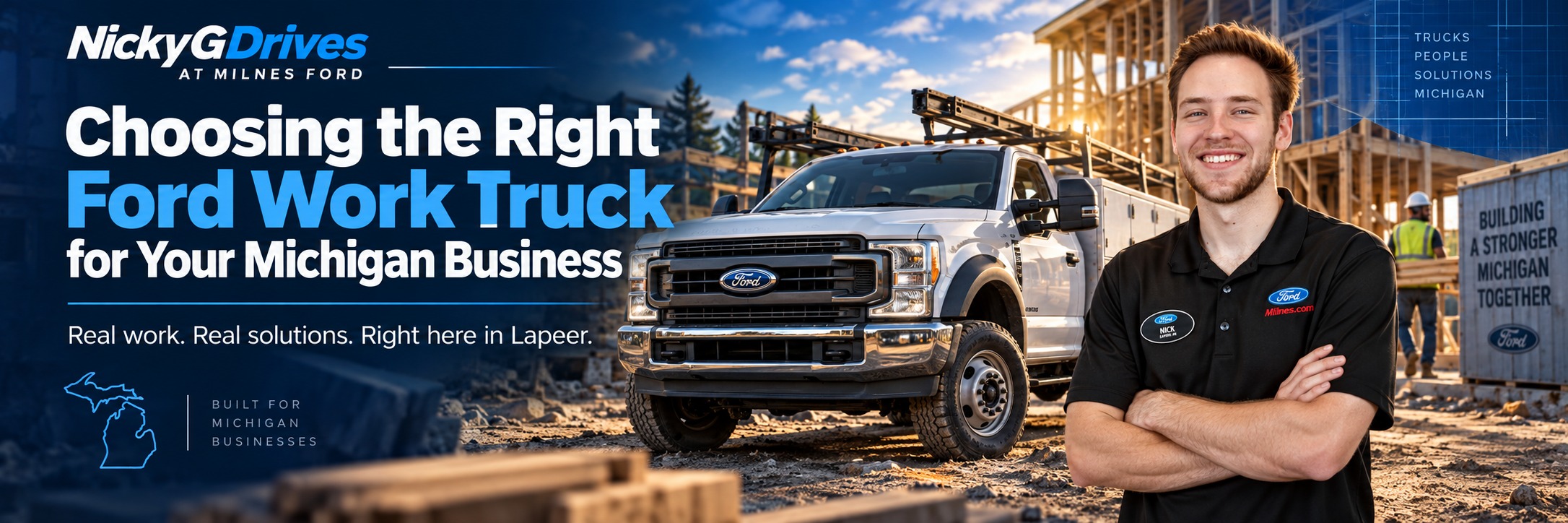
A productive work-truck appointment starts before anyone walks around the lot. The more clearly you can describe the job, the easier it is to have a useful conversation about the vehicle that will do it. That does not mean arriving with every technical answer. It means bringing the information your business already knows instead of beginning and ending with a model name.
Think of the appointment as matching a working day to a specific vehicle configuration. The truck needs to carry the right people and equipment, fit the places you use it and support the work you expect over time. Here is a practical preparation checklist for that discussion with Nick at Milnes Ford in Lapeer.
Describe a normal day and a demanding day
Write a short description of what the truck will do. Include where the day begins, how many stops are typical, whether the route includes job sites and what returns with the vehicle at the end of the day. A landscaper's daily load can differ from an electrician's even when both businesses are considering a pickup.
Then describe a demanding but realistic day. Perhaps an extra employee rides along, a particular machine is loaded or the truck tows a trailer while also carrying tools. Do not choose a vehicle only around the lightest version of the job if heavier work is a regular part of the plan.
Separate recurring needs from rare possibilities. A hypothetical task you may never take on should not automatically determine the purchase. At the same time, a predictable seasonal workload belongs in the discussion before you select a configuration.
Bring a list of the people and equipment
List the usual occupants, permanent accessories and cargo. Include items that are easy to forget because they stay with the truck: toolboxes, racks, bed equipment and other installed components. Record actual weights when available and clearly mark estimates.
Ford explains that payload includes occupants and cargo, and added equipment uses part of the available allowance. Trailer tongue or kingpin weight also contributes to payload. The specific vehicle's label and applicable documentation matter; a maximum advertised for a model line is not the rating of every truck in that line. See Ford's payload explanation for the underlying terms.
Bring the list even when some entries are incomplete. An honest 'weight not confirmed' gives the salesperson and qualified upfitter a question to resolve. A confident guess can lead the discussion in the wrong direction.
Measure the things that must fit
Weight is only one part of the job. Record the dimensions of the largest equipment and the space needed to load, unload or secure it. Note whether an item fits flat, must stand upright or needs access from a particular side. Photographs can help explain an awkward shape.
Measure the spaces the vehicle will use, too. A garage opening, a covered loading area, a narrow driveway or a regularly used parking structure can affect the choice. Include any planned accessories when discussing overall height and clearance; do not rely only on the base vehicle's dimensions.
Bring measurements as a starting point for verification, not as a substitute for checking the actual vehicle and completed setup. A drawing of a parking space and a photograph of the entrance can make a constraint much easier to discuss than 'it is a little tight.'
Bring the trailer's information, not just its length
If towing is part of the job, bring the trailer's identification and rating information, details of its actual working load and the equipment used with it. A trailer's length alone does not establish what the truck must handle. Neither does an empty-trailer weight describe every loaded trip.
Tell Nick whether you already own the trailer or are still choosing one. If you are still planning, say which details are tentative. It is better to coordinate the truck and trailer decisions than to discover that assumptions made for one do not fit the other.
Ask for a configuration-specific review using the appropriate manufacturer information. The review should consider the actual equipment, loading and relevant ratings together. This article is a preparation guide, not a towing calculation or a substitute for the instructions supplied with the vehicle and trailer.
Explain what is wrong with the current setup
Your current vehicle can provide useful evidence. Write down the problems that make work harder: equipment that is difficult to reach, too little usable storage, awkward passenger access or a body style that does not suit the tasks. Distinguish these working problems from preferences such as color or appearance.
A few photographs of the current loaded setup may be more helpful than a long verbal description. Remove personal information, customer addresses and anything confidential before sharing them. Show the storage arrangement and access problem clearly rather than trying to make the old vehicle look its best.
Also note what works well. Perhaps the cab arrangement suits your crew or a particular storage system keeps frequently used tools accessible. A replacement discussion should preserve useful features rather than assuming everything about the current setup needs to change.
Bring a short account of who will drive the vehicle and how it is shared. Different drivers may need different seating adjustments or access to the equipment, and a supervisor may need a clear way to check that the truck returns ready for the next day. Write down those working arrangements without including employees' private information. The appointment is not a substitute for your own operating policies, but the way the business assigns and uses the truck can help explain which practical features deserve attention during the comparison.
Bring an upfit plan, even if it is only a sketch
If you expect to add a service body, racks, storage, specialized equipment or another upfit, include that plan at the beginning. Identify the proposed equipment, the intended installer and any requirements already supplied by the upfitter. Mark unconfirmed details instead of treating them as settled.
A preliminary sketch can show how you want to use the vehicle, but it does not establish that the proposed installation is suitable. Mounting, electrical requirements, weight distribution and compatibility need the appropriate qualified review. Avoid buying components solely because a similar-looking truck carries them.
Ask who will coordinate the base vehicle and the upfit. A clear handoff should identify the people responsible for confirming requirements and the documents used to do it. The purchase discussion should not leave you assuming somebody else has already checked those details.
Separate must-haves from preferences
Use three groups: essential to perform the work, valuable for daily use and preferred if the right configuration is available. This prevents a discussion about appearance or convenience from crowding out a requirement that determines whether the vehicle is suitable.
For example, a required passenger arrangement belongs in the first group if it affects how the crew travels. A preferred upholstery choice may belong in the third. Your categories will be specific to your business; there is no universal list that makes the same choice right for everyone.
When two requirements compete, ask what changes would resolve the conflict. You may need a different configuration, a revised equipment plan or a separate discussion with an upfitter. Do not silently drop a working requirement just to make a vehicle already on the lot appear to fit.
Discuss timing in concrete terms
Explain when the vehicle needs to be usable and what happens if that timing changes. A target for the base vehicle's arrival is not necessarily the same as a completed, upfitted vehicle ready for work. Identify which date matters to your business.
Ask which parts of the schedule are confirmed and which are estimates. Availability, preparation, outside installation and delivery may involve different people. Keep those steps separate in your notes rather than reducing everything to a single optimistic date.
Do not dispose of the current work vehicle or commit a job around an unconfirmed delivery assumption. Build the timing discussion around actual information and a practical contingency. Nick can help review the options available for your circumstances without this article promising inventory or a delivery deadline.
Compare the complete plan, not one line of a quote
When comparing proposals, make sure they refer to comparable vehicles and equipment. Record the exact configuration, included items, excluded items and any separately arranged work. A lower headline number may describe a different setup, not a better price for the same thing.
Ask for unclear items to be explained in writing before making a decision. Keep vehicle pricing, upfit estimates and other arrangements identifiable. Financing or tax questions should be handled through the appropriate qualified people and current documents, not assumptions from a general blog article.
The goal is a comparison you can understand later, after the conversation has ended. A photograph of a window sticker, a written configuration summary and a dated quote can be more useful than relying on memory of a busy appointment.
Leave with a short list of verified next steps
Before finishing, identify what has been confirmed and what still needs checking. An unresolved equipment weight, a trailer detail or an upfitter requirement should have a named next step. 'We will look into it' is easier to follow when you know who is checking which question.
Keep the preparation sheet with the vehicle information so later changes can be compared against the original work requirements. If the crew, load or intended upfit changes, return to those requirements before treating the earlier discussion as final approval.
Start with the NickyGDrives commercial-vehicle page and contact Nick to discuss your needs. You do not have to arrive with a perfect specification. Bring a clear picture of the work, and make the unanswered questions visible.
- 01Describe the work
- 02List people and equipment
- 03Bring trailer details
- 04Compare exact vehicles
Original editorial workflow illustration—not measured performance or a claim about a live system.
| Bring | Record | Still needs confirmation |
|---|---|---|
| Job description | Normal and demanding working days | Exact vehicle suitability |
| Equipment list | Dimensions and verified or estimated weights | Completed configuration and relevant ratings |
| Trailer details | Identification and loaded-use information | Configuration-specific towing review |
| Timing plan | Required usable date and contingency | Vehicle and upfit schedules |