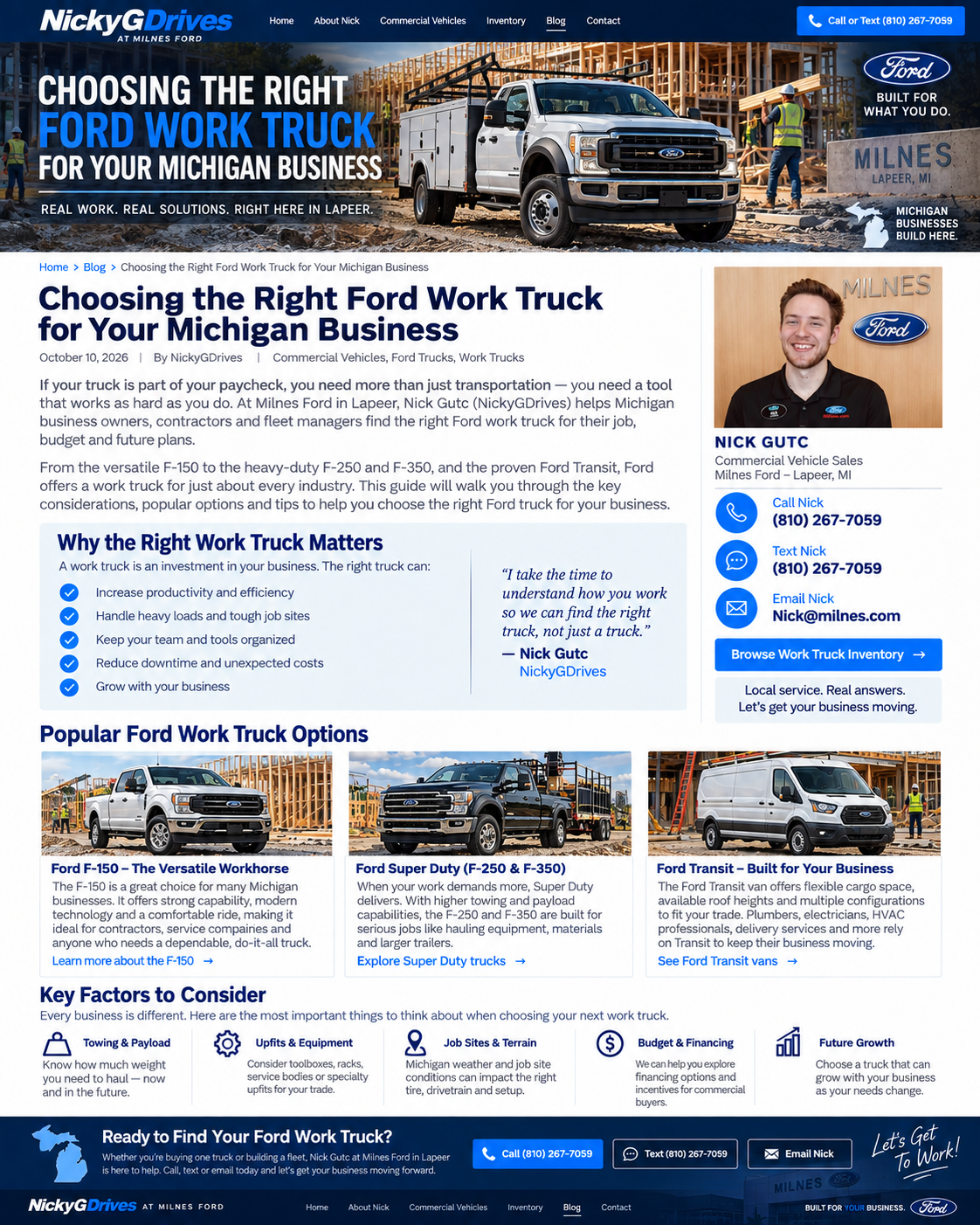
A practical buying guide from NickyGDrives, your direct connection to Nick Gutc at Milnes Ford in Lapeer.
Begin with the work, not the badge
The truck that looks impressive on a lot is not necessarily the truck that earns its keep in your business. Start by describing a typical workday: how far you drive, what you carry, whether you tow, how many coworkers ride with you and where you park. A landscape contractor, a plumbing company and a construction supervisor may all use pickups, but they need different combinations of payload, cargo access, space and maneuverability. Writing those requirements down before shopping helps you avoid spending on equipment you do not use—or buying a truck that cannot comfortably handle the tasks you do every day. A straightforward conversation about your actual work is the best starting point.
Payload is more than what goes in the bed
Payload includes the weight of passengers, tools, supplies, cargo and many installed accessories. A toolbox, ladder rack or service body may use some of the available carrying capacity before the first bag of material is loaded. Never rely on the largest payload figure advertised for an entire model family: equipment, cab, drivetrain and configuration can change a particular truck's rating. Review the certification label and vehicle-specific documentation, and consider how much you carry on the heaviest normal workday. Choosing with a reasonable operating margin can prevent an unpleasant surprise after the vehicle is outfitted.
Make towing calculations using your actual trailer
If you move equipment or materials on a trailer, estimate the trailer's loaded weight rather than its empty advertised weight. Tongue or pin weight, passengers and cargo in the truck all matter. Trailer brakes, proper hitch equipment, axle ratings and the truck's specific tow rating should be reviewed together. Some businesses need to pull a trailer occasionally; others pull one every day, through varied weather and terrain. Those are different buying decisions. Compare the exact vehicle and its equipment against the intended use before choosing between a lighter-duty or heavier-duty pickup.
F-150 versus Super Duty
A Ford F-150 is often worth considering for mixed personal and professional driving, daily business visits and many general pickup tasks. Ford Super Duty trucks, including F-250 and F-350 configurations, are designed for applications where buyers may need greater heavy-duty capability. That does not mean every Super Duty is automatically the right choice, or that every F-150 has identical capability. The best fit depends on verified towing and payload ratings, size, route conditions, operating costs and how much of the workday is spent hauling. A commercial buyer should compare specific available vehicles rather than make the decision from model names alone.
Cab style, bed configuration and daily access
Crew members, materials and tools compete for space. If several employees ride together regularly, passenger accommodation may be a priority. If the vehicle carries long items, bed dimensions and how you secure loads are crucial. Also think about how workers climb in and out, access equipment, back into job sites and maneuver through tight driveways or loading areas. The best configuration helps people work efficiently—not just travel to the job. Consider a full day of stops rather than the few minutes spent on a test drive.
Upfits should be part of the purchase conversation
Commercial truck equipment may include racks, utility bodies, storage systems, liftgates and other specialized components. Talk about planned modifications early. The added weight, mounting requirements and electrical demands may affect your vehicle choice. An upfit can also influence maintenance access and how long a vehicle is out of service during installation. Nick can help begin the vehicle-selection conversation at Milnes Ford; any final compatibility questions should be verified with the applicable vehicle and upfit specialists before ordering or installation.
Michigan work conditions and ownership costs
Consider winter starts, traction needs, road conditions, commuting distance and where the vehicle will be stored. Beyond purchase price, budget for fuel, insurance, service intervals, tires, financing and expected downtime. The most economical truck is not necessarily the one with the smallest sticker price if it is poorly suited to the job. A business vehicle decision is stronger when you compare expected operating demands and long-term costs. Bring those questions to the dealership so you can evaluate realistic options rather than assumptions.
A practical checklist before visiting Milnes Ford
Bring a short description of what the truck must do, the heaviest materials or equipment you carry, trailer details if applicable, preferred cab and bed layout, and your approximate timeline. Note any planned commercial equipment and whether you need one truck or multiple vehicles. If you are replacing an existing vehicle, identify what works well and what causes problems now. Then review available inventory and ask questions about specific trucks, not just the product brochure. This creates a focused discussion that respects your time.
Contact Nick Gutc in Lapeer
Nick Gutc is a sales professional at Milnes Ford in Lapeer, Michigan. To explore possible work-truck options, browse the commercial inventory and contact Nick directly with your requirements. Call or text (810) 267-7059. Inventory changes, and the availability, pricing and specifications of individual vehicles should always be confirmed with Milnes Ford before making a purchase decision.
Frequently asked questions
Should I buy a truck before choosing an upfit?
If the upfit is central to your work, settle the requirements together. Ask what the equipment weighs, how it mounts and which truck configurations it supports. A vehicle that looks suitable on paper may not be compatible with a specialized body.
Does a heavier-duty badge guarantee higher towing capacity?
No. Ratings differ by vehicle configuration and equipment. Compare the exact truck, its labels and manufacturer documentation. The trailer and loading details are just as important as model family.
What should I tell Nick before I visit?
Share your current vehicle, your heaviest typical loads, your trailer if any, your work-site access needs and the equipment you plan to install. A few clear details make it easier to narrow available inventory.
Explore commercial inventory, meet Nick Gutc, or contact Nick directly. You can call or text (810) 267-7059.
Review what has changed since your current vehicle
If you already own a business vehicle, compare the tasks it handles well with the frustrations you face. Maybe the cargo area is disorganized, the cab is cramped, or towing adds stress to certain routes. Sometimes a different configuration solves the problem better than switching to an entirely different vehicle category. Bring examples from real workdays, not just a broad wish list. The clearer you are about the problem, the easier it becomes to evaluate a practical solution.
Keep the purchasing conversation grounded
Specifications and availability can change, and individual vehicles on the lot may have different packages or equipment. Ask for the vehicle-specific details and clarify what is included in the quoted price. Confirm any planned equipment, financing assumptions or delivery timing in writing. The website is a helpful starting point, but the final purchase should be based on verified information from Milnes Ford and the exact vehicle you select.
Plan the first week of ownership
Think about insurance, driver familiarization, equipment storage, preventive maintenance and the time required to get the vehicle ready for work. A new truck or van is only productive when it fits into the daily operation. If you need shelving, racks or other modifications, discuss the installation timeline before committing to a specific delivery date. That reduces the chance of buying a capable vehicle that sits unused while waiting for necessary equipment.